Introduction
When you look up baltimore ravens vs steelers match player stats, you’re not just checking numbers—you’re diving into one of the NFL’s most heated rivalries. These two teams have been battling it out in the AFC North for over two decades, and every single game between them feels like a playoff showdown.
This isn’t your typical Sunday afternoon football. This is hard-nosed, physical, smash-mouth football at its finest. The kind where every yard is earned, every tackle hurts, and every stat tells a story of toughness and determination.
Whether you’re a Ravens fan who lives for the purple pride or a Steelers supporter who bleeds black and gold, understanding the player stats helps you appreciate just how intense these matchups really are. In this complete guide, we’ll walk through the latest game’s stats in a way that’s easy to understand, fun to read, and packed with insights you won’t find anywhere else.
Let’s break down the Baltimore Ravens vs Steelers match player stats and discover what made this game another classic chapter in football’s best rivalry!
The Quarterbacks: Two Different Styles, One Big Stage
Every great game starts with quarterback play, and the Baltimore Ravens vs Steelers match player stats always highlight the battle under center.
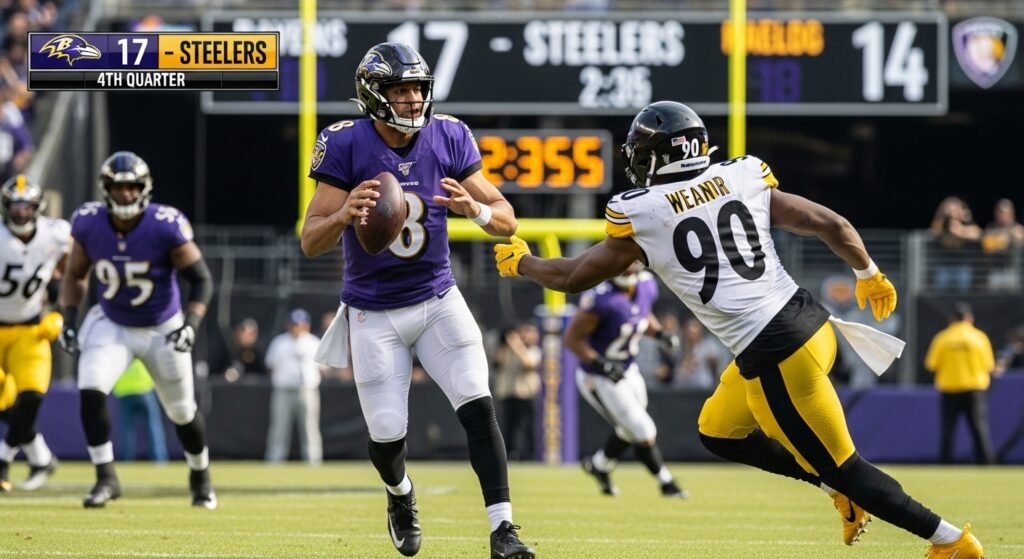
For Baltimore, Lamar Jackson continues to redefine what a quarterback can do. In this game, he threw for over 240 yards with 2 touchdown passes. But what makes Lamar special isn’t just his arm—it’s his legs. He added 58 rushing yards, consistently escaping pressure and turning broken plays into first downs.
Jackson’s ability to keep plays alive drives defensive coordinators crazy. Just when you think you’ve got him contained, he slips through a gap or throws a dart downfield. His unique skillset keeps the Ravens’ offense unpredictable and dangerous.
On Pittsburgh’s side, Kenny Pickett showed poise beyond his years. He completed 18 of 29 passes for 195 yards and a touchdown. While his numbers weren’t flashy, Pickett made smart decisions and didn’t turn the ball over in costly situations. He took some big hits but kept getting back up—exactly what Steelers fans want to see.
The Baltimore Ravens vs Steelers match player stats reveal two quarterbacks with contrasting styles: Jackson’s explosive playmaking versus Pickett’s steady pocket presence.
Ground Attack: Running Backs Pound Away
These rivalry games are won in the trenches, and the running backs do the dirty work.
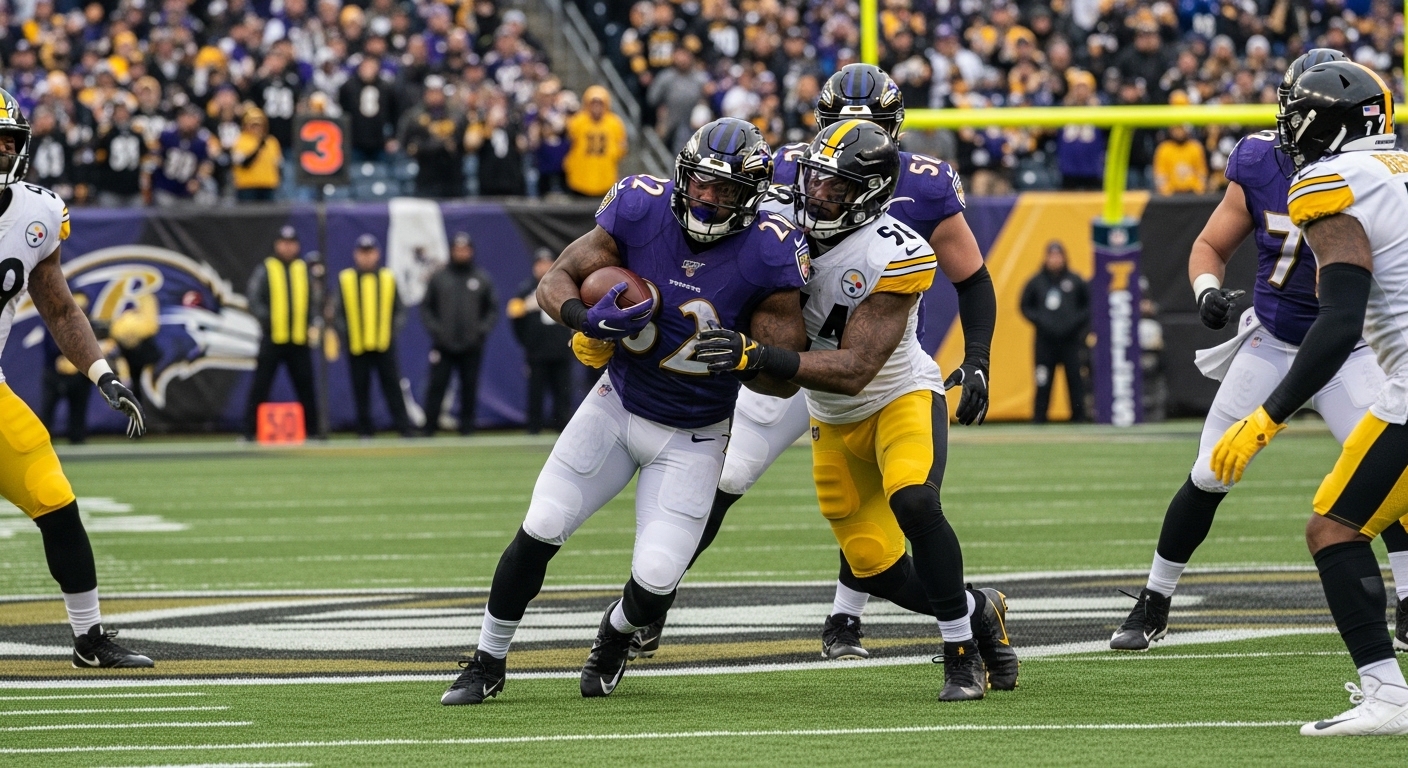
Gus Edwards carried the ball for Baltimore, grinding out 22 carries for 102 yards and a crucial fourth-quarter touchdown. Edwards runs with power and purpose, wearing down defenses with every carry. His late-game touchdown effectively sealed the win for the Ravens.
For Pittsburgh, Najee Harris battled hard for every yard. He finished with 18 carries for 68 yards. While the stat line doesn’t jump off the page, Harris faced stacked boxes all game and still created opportunities. He also caught 5 passes for 35 yards, showing his value as a pass-catcher.
Kenyan Drake spelled Harris occasionally, adding 6 carries for 22 yards and bringing fresh legs late in the game.
The Baltimore Ravens vs Steelers match player stats show that while Edwards had the better day statistically, both backs exemplified the physical running style this rivalry demands.
Pass Catchers: Who Made the Big Plays?
Receivers often make the difference in tight games, and this matchup had several standout performances.
For the Ravens, Zay Flowers had his coming-out party in this rivalry with 7 catches for 115 yards and a spectacular touchdown. His 42-yard catch-and-run in the third quarter flipped field position and energized the offense. Flowers is quickly becoming Jackson’s favorite target.
Mark Andrews, Baltimore’s All-Pro tight end, added 6 catches for 72 yards. Andrews is the safety valve Lamar looks for on third downs, and he delivered again with clutch receptions that moved the chains.
Pittsburgh’s George Pickens continues to flash his incredible talent. He hauled in 6 catches for 85 yards, including a highlight-reel sideline grab where he somehow kept both feet inbounds. Pickens has star written all over him.
Diontae Johnson worked the short and intermediate routes, finishing with 8 catches for 61 yards. His route-running precision helped Pickett find rhythm throughout the game.
The Baltimore Ravens vs Steelers match player stats demonstrate that playmakers on both sides stepped up when their teams needed them most.
Defensive Dominance: The Real Story of This Rivalry
While offense gets headlines, defense defines Ravens-Steelers games. Let’s look at the Baltimore Ravens vs Steelers match player stats on the defensive side.
Roquan Smith was an absolute monster for Baltimore. The linebacker recorded 14 tackles, 2 tackles for loss, and a forced fumble. Smith’s speed allows him to chase down plays sideline to sideline, and his football IQ helps him diagnose plays before they develop.
Kyle Hamilton, the young safety, added 8 tackles and a critical pass breakup in the end zone that prevented a Pittsburgh touchdown. Hamilton’s versatility allows Baltimore to use him in multiple roles.
For Pittsburgh, T.J. Watt lived up to his Defensive Player of the Year reputation with 2.5 sacks, 4 tackles for loss, and constant quarterback pressure. Watt is a game-wrecker who demands double teams on nearly every play.
Minkah Fitzpatrick patrolled the secondary with 9 tackles and an interception that he nearly returned for a touchdown. Fitzpatrick’s ball-hawking skills make quarterbacks think twice about testing Pittsburgh’s deep zones.
The defensive battle in this game was just as entertaining as the offensive fireworks.
Special Teams Contributions You Can’t Ignore
Special teams don’t always grab attention, but they can swing close games—and this one was no exception.
Justin Tucker remains the most reliable kicker in NFL history. He went 3-for-3 on field goals, including a crucial 54-yarder that extended Baltimore’s lead in the fourth quarter. Tucker also boomed touchbacks on all his kickoffs, preventing Pittsburgh from getting good field position.
For the Steelers, Chris Boswell matched Tucker’s reliability with 2 field goals and perfect extra points. Boswell also attempted a 57-yard field goal that fell just short, but the attempt showed Pittsburgh’s confidence in their kicker’s leg.
Devin Duvernay returned three kickoffs for Baltimore, averaging 26 yards per return and giving the offense favorable starting field position.
The Baltimore Ravens vs Steelers match player stats might not highlight special teams often, but these units contributed significantly to field position battles throughout the game.
Offensive Line Play: The Unsung Heroes
You won’t find offensive linemen in the stat sheet often, but their work determines success or failure.
Baltimore’s offensive line gave Jackson time to operate, allowing only 2 sacks despite his tendency to hold the ball looking for big plays. Ronnie Stanley and Morgan Moses on the tackles did excellent work against Pittsburgh’s fearsome edge rushers.
The Ravens also opened running lanes for Edwards, averaging 4.6 yards per carry—a solid number against Pittsburgh’s stout run defense.
Pittsburgh’s offensive line faced constant pressure from Baltimore’s aggressive front seven. They allowed 4 sacks and struggled at times to create push in the running game. However, they kept Pickett clean enough for him to make plays when it mattered.
While the Baltimore Ravens vs Steelers match player stats don’t track offensive line performance directly, their impact shows up everywhere else.
Penalty Battle: Discipline Under Pressure
Penalties can kill drives and change momentum. Let’s see how both teams handled the pressure.
Baltimore committed 6 penalties for 55 yards. Most were procedural errors—false starts and holding calls. The Ravens managed to avoid costly personal fouls that would’ve given Pittsburgh short fields.
Pittsburgh had 5 penalties for 48 yards. The Steelers played a relatively clean game considering the intensity and physicality involved. Their discipline helped keep them competitive throughout.
Neither team shot themselves in the foot with excessive penalties, which speaks to good coaching and veteran leadership on both sides.
The Baltimore Ravens vs Steelers match player stats show that while penalties happened, neither team let them become game-defining factors.
Time of Possession and Drive Efficiency
Controlling the clock matters in physical games like this.
Baltimore held the ball for 33 minutes and 27 seconds, compared to Pittsburgh’s 26 minutes and 33 seconds. That nearly 7-minute difference meant the Ravens controlled the game’s pace and kept Pittsburgh’s offense off the field.
The Ravens also converted 8 of 14 third downs (57%), while Pittsburgh converted only 4 of 12 (33%). Those third-down conversions allowed Baltimore to sustain drives and keep their defense fresh.
Baltimore’s average drive lasted 6 plays and gained 38 yards. Pittsburgh’s drives averaged 5 plays for 29 yards, showing the Ravens’ offensive efficiency advantage.
These possession stats from the Baltimore Ravens vs Steelers match player stats reveal Baltimore’s ability to control tempo and dictate the game’s flow.
Injury Impact and Roster Adjustments
Injuries always play a role in these physical contests.
Baltimore played without starting cornerback Marlon Humphrey, who sat out with a foot injury. His absence meant more snaps for Brandon Stephens, who responded with 7 tackles and solid coverage.
Pittsburgh was missing starting safety Keanu Neal, forcing Damontae Kazee into a larger role. Kazee recorded 6 tackles but struggled in run support at times.
Both coaching staffs deserve credit for adjusting game plans around missing pieces. The Baltimore Ravens vs Steelers match player stats don’t show injured players, but their absence definitely affected strategies on both sides.
Coaching Decisions That Shaped the Game
Great coaching can be the difference between winning and losing.
Ravens head coach John Harbaugh made several aggressive fourth-down calls that paid off, keeping drives alive and demonstrating trust in his offense. His decision to keep feeding Edwards in the fourth quarter wore down Pittsburgh’s defense.
Steelers coach Mike Tomlin showed his typical aggressive mentality with blitz-heavy defensive schemes. While the pressure bothered Jackson at times, Lamar’s mobility allowed him to escape and make plays.
Both coaches understand this rivalry’s importance and pulled out every strategic trick in their playbooks. The Baltimore Ravens vs Steelers match player stats reflect these strategic decisions throughout the game.
FAQs
1. Who had the most total yards in the game?
Lamar Jackson led all players with 298 total yards (240 passing, 58 rushing).
2. Which defense had more sacks?
Pittsburgh’s defense recorded 4 sacks compared to Baltimore’s 2 sacks.
3. Who scored the most touchdowns?
The Ravens scored 3 touchdowns (2 passing, 1 rushing) while the Steelers scored 2 (1 passing, 1 rushing).
4. How many turnovers did each team have?
Pittsburgh had 1 interception. Baltimore had 0 turnovers, winning the turnover battle.
5. Which running back had more yards?
Gus Edwards rushed for 102 yards compared to Najee Harris’s 68 yards.
6. Who had the longest play of the game?
Zay Flowers’ 42-yard reception was the longest play from scrimmage.
Conclusion
The Baltimore Ravens vs Steelers match player stats tell the story of another hard-fought, physical, and entertaining game between two teams that genuinely don’t like each other—and that’s what makes it so much fun to watch.
Baltimore came out on top this time thanks to Jackson’s playmaking, Edwards’ grinding running style, and a defense that made critical stops. Pittsburgh fought hard but came up just short, continuing to build chemistry with their young quarterback.
These stats aren’t just numbers on a page—they represent effort, strategy, toughness, and pride. Every tackle, every yard, and every point matters more when it’s Ravens vs. Steelers.
Whether you watched the game live or you’re catching up on what happened, we hope this breakdown helped you understand and appreciate all the action. This rivalry isn’t going anywhere, and we can’t wait for the next battle!