Introduction
Golf has many different ways to play, and one of the most fun and exciting formats is fourball matchplay. If you’ve ever watched the Ryder Cup or Presidents Cup, you’ve probably seen this format in action. Two teams of two players compete against each other, and the thrill of teamwork combined with individual brilliance makes it unforgettable.
But here’s the thing—many golfers, even experienced ones, don’t fully understand the rules of fourball matchplay. They know the basics but get confused about specific situations like concessions, handicap strokes, or what happens when a player picks up their ball. Sound familiar? Don’t worry. You’re not alone.
In this article, we’re going to walk through the rules of fourball matchplay in a way that’s super easy to understand. Whether you’re a beginner picking up your first set of clubs or someone who’s played for years but never learned the official rules, this guide has you covered.
We’ll explain how teams work, how holes are won, what happens with penalties, and all those little details that make this format so unique. By the end, you’ll feel confident stepping onto the first tee in your next fourball matchplay event.
So let’s tee it up and learn the game together!
What Exactly Is Fourball Matchplay?
Let’s start with the basics. In fourball matchplay, four golfers play together in two teams of two. Each player plays their own ball throughout the entire round. At the end of each hole, the team uses the lowest individual score between their two players. That best score is then compared against the best score from the opposing team.
For example, imagine Player A scores a 4 and Player B scores a 5 on the same hole. Their team score for that hole is 4. If the other team’s best score is a 5, then the first team wins that hole.
Understanding the rules of fourball matchplay starts with this simple concept—every player plays their own ball, and only the best score counts. You don’t add scores together. You don’t alternate shots. Each golfer plays independently, but the team benefits from whichever partner performs best on each hole.
This format encourages aggressive play because if one partner is in trouble, the other can still save the hole. It creates exciting moments and plenty of drama.
How Are Holes Won, Lost, or Halved?
In matchplay, you don’t count total strokes at the end of the round like you do in stroke play. Instead, you count holes won. Each hole is a separate mini-competition between the two teams.
If one team has a better score on a hole, they win that hole and go “1 up.” If both teams have the same best score, the hole is “halved,” and nobody gains an advantage. The match continues hole by hole.
The rules of fourball matchplay state that the team leading by more holes than remain is the winner. For example, if one team is 3 up with only 2 holes left, the match is over because the losing team can’t catch up. This would be written as a “3 and 2” victory.
If the match is tied after 18 holes, it can either end as a draw or go to extra holes, depending on the competition rules. This hole-by-hole format creates constant tension and excitement throughout the round.
Order of Play: Who Goes First?
Knowing when to hit is important. On the first tee, the order is usually decided by the competition draw or by a coin flip. After that, the team that won the previous hole has the “honor” and tees off first on the next hole.
Within a team, either partner can play first. There’s no strict requirement about which teammate hits before the other. However, there is a strategic element here. Sometimes a team will send one player to hit a safe shot first, giving the second player freedom to take a more aggressive approach.
The rules of fourball matchplay also allow players from different teams to agree on a different order during a hole if it helps with pace of play. This is common on the green when a player farther from the hole would normally go first.
Understanding order of play helps the game flow smoothly and prevents unnecessary delays. It’s one of those small but important details that experienced golfers appreciate.
Concessions: The Gentleman’s Rule
One of the most unique aspects of matchplay is the concession. A concession happens when one team tells the other team that they don’t need to finish a putt or even a hole. It’s basically saying, “We’ll give you that one.”
For example, if your opponent has a two-foot putt for par, you might concede it instead of making them putt. This speeds up play and shows sportsmanship. However, once a concession is made, it cannot be taken back. The rules of fourball matchplay are very clear about this.
You can concede a putt, a hole, or even the entire match. But you must be careful. Conceding too quickly could hurt your team, and not conceding at the right time could slow down the game.
In professional events like the Ryder Cup, concessions are highly strategic. Teams use them to apply pressure or to move on quickly from holes they can’t win. Understanding concessions is essential for anyone learning the rules of fourball matchplay.
Handicaps in Fourball Matchplay
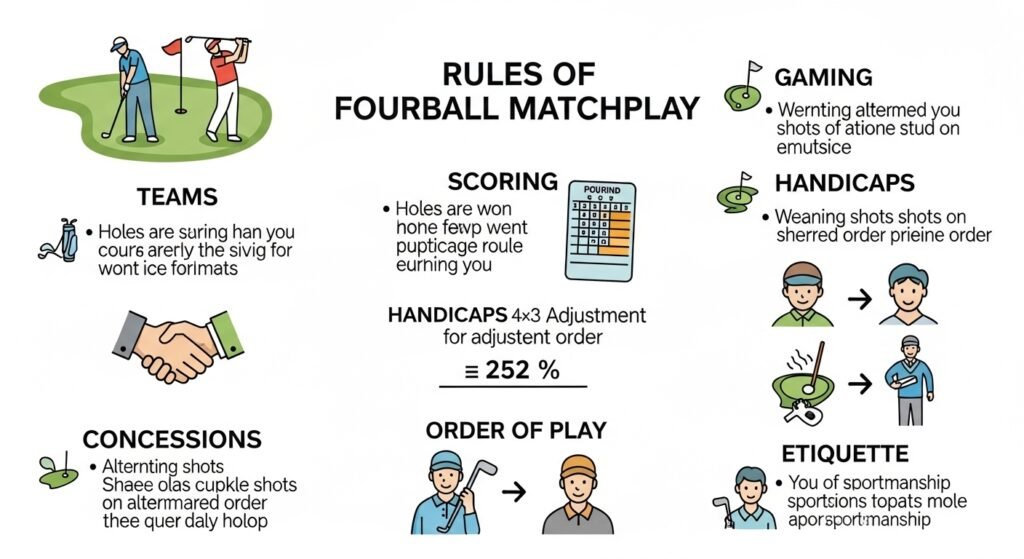
Handicaps make the game fair for players of different skill levels. In fourball matchplay with handicaps, each player receives a certain number of strokes based on their handicap index. These strokes are applied to specific holes determined by the course’s stroke index.
The rules of fourball matchplay state that the player with the lowest handicap plays off scratch, meaning zero extra strokes. The other three players then receive the difference between their handicap and the lowest handicap. This creates a level playing field where every player has a fair chance.
For example, if the four players have handicaps of 5, 10, 15, and 20, the player with 5 plays off scratch. The player with 10 gets 5 strokes, the player with 15 gets 10 strokes, and the player with 20 gets 15 strokes. These strokes are then applied to the hardest-rated holes on the course.
Handicap strokes can completely change the outcome of a hole. A bogey with a stroke becomes a net par, which could win the hole. Understanding how handicaps work is crucial for fair and competitive fourball matchplay.
Penalties: What Happens When Rules Are Broken?
Penalties in fourball matchplay work slightly differently than in stroke play. If one player on a team breaks a rule, the penalty usually only affects that player, not their partner. This is an important distinction.
For example, if Player A accidentally moves their ball on the green, Player A gets a one-stroke penalty. But Player B is not affected. Player B’s score still counts for the team. This means one partner can make a mistake without necessarily costing the team the hole.
However, the rules of fourball matchplay do include situations where both partners can be penalized. If a team commits a serious breach, like agreeing to ignore a rule to benefit their match, both players can be disqualified from the hole or even the match.
Understanding penalties helps you play with confidence. You know what’s allowed, what’s not, and what the consequences are. This knowledge prevents disputes and keeps the game enjoyable for everyone.
Can You Pick Up Your Ball During a Hole?
Yes, and this is one of the best things about fourball matchplay. Since only the best score counts for each team, a player can pick up their ball at any time during a hole without penalty. This is perfectly fine under the rules of fourball matchplay.
Why would someone do this? Let’s say Player A has already scored a par on a hole, and Player B is lying five shots and nowhere near the green. Player B can simply pick up their ball because their score won’t help the team. This saves time and keeps the pace moving.
Picking up your ball is common and encouraged in matchplay. It prevents slow play and lets players focus on holes where they can actually contribute. It’s one of the reasons fourball matchplay tends to be faster and more enjoyable than some other formats.
Just remember—you can’t pick up your opponent’s ball. Only your own. And if your partner has already picked up, you need to finish the hole if your score might matter.
Strategy Tips for Fourball Matchplay
Knowing the rules of fourball matchplay is one thing. Using them to your advantage is another. Smart strategy can make a huge difference in your results.
One common strategy is the “one safe, one aggressive” approach. On each hole, one partner hits a conservative shot to ensure the team gets a decent score. The other partner then takes a riskier shot, aiming for a birdie or even an eagle. If the risky shot works, the team gets a great score. If it doesn’t, the safe shot protects them.
Another strategy involves reading your opponents. If they’re both in trouble, you don’t need to take risks. Just make a solid par and let them make mistakes. If they’re both playing well, you might need to push harder.
Communication between partners is also vital. Talk about club selection, read greens together, and keep each other’s spirits up. Fourball matchplay is a team sport, and good partnerships often beat more talented individuals.
Common Mistakes Players Make in Fourball Matchplay
Even experienced golfers make mistakes in fourball matchplay. One common error is forgetting about handicap strokes. Players sometimes forget to apply their strokes on the correct holes, which can lead to disputes and incorrect results.
Another mistake is playing too conservatively. Since your partner can back you up, fourball matchplay is the perfect format to be aggressive. Going for pins, attempting long putts, and taking on risky shots can pay off because your partner provides a safety net.
Some players also forget about the rules of fourball matchplay regarding wrong ball situations. Playing the wrong ball results in a loss of hole in matchplay—a severe penalty. Always double-check your ball before hitting.
Not communicating with your partner is another big mistake. Talk about strategy, share information about wind and distances, and support each other throughout the round. Teams that communicate well almost always outperform teams that play in silence.
Finally, some players don’t understand concessions properly. They either concede too much or refuse to concede anything. Finding the right balance shows sportsmanship and smart tactical thinking.
Fourball Matchplay vs Other Golf Formats
Golf has many formats, and it helps to understand how fourball matchplay compares to others. In foursomes, teammates alternate shots with one ball. That’s very different from fourball, where each player plays their own ball.
In stroke play, you count every single shot over 18 holes. The lowest total wins. There are no concessions, no hole-by-hole battles, and no picking up. Stroke play rewards consistency, while matchplay rewards aggressiveness and clutch performance.
The rules of fourball matchplay make it unique because of the team dynamic combined with individual play. You play your own ball but benefit from your partner’s performance. It’s the perfect blend of individual skill and teamwork.
Fourball matchplay is commonly used in prestigious team events like the Ryder Cup, Presidents Cup, and many amateur competitions worldwide. Its popularity continues to grow because it’s exciting, social, and strategically fascinating.
If you’ve only ever played stroke play, trying fourball matchplay will give you a whole new appreciation for the game of golf.
Etiquette and Sportsmanship in Fourball Matchplay
Golf is a game built on honor and respect, and fourball matchplay is no exception. Good etiquette includes being quiet when others are hitting, repairing divots and ball marks, and maintaining a good pace of play.
In matchplay specifically, conceding putts at the right time shows class. Congratulating opponents on great shots builds mutual respect. And handling disagreements calmly and according to the rules of fourball matchplay keeps the game enjoyable.
It’s also important to keep score accurately. Both teams should agree on the match status after every hole. This prevents confusion later and ensures fair play throughout the round.
Being a good partner matters too. Encourage your teammate, stay positive after bad shots, and celebrate good ones together. Matchplay is emotional, and the best teams keep their composure regardless of the situation.
Sportsmanship isn’t just about following rules—it’s about playing with integrity, respect, and class. These values are what make golf such a special sport.
What Happens When the Match Is Tied?
If the match is all square after 18 holes, the outcome depends on the competition rules. In some events, a tied match simply remains a draw, and each team gets half a point.
In other competitions, the match goes to extra holes, also called sudden death. Teams play additional holes until one team wins a hole. The rules of fourball matchplay during extra holes are the same as during the regular round—each player plays their own ball, and the best score counts.
Extra holes create incredible drama. The pressure is intense, and every shot matters even more. Many famous matches in Ryder Cup history have been decided by extra holes.
Understanding what happens in a tie is important before you start your match. Check with the competition organizer or review the event rules so you’re prepared for any outcome.
The Role of the Referee or Committee
In official competitions, a referee or committee oversees the match. They make rulings on disputed situations, ensure the rules are followed, and handle any issues that arise during play.
Players can request a ruling at any time. If you’re unsure about a rules of fourball matchplay situation, ask for help rather than guessing. Getting a wrong ruling can cost you a hole or even the match.
In casual games without a referee, both teams should agree on how to handle rule disputes. The best approach is to know the rules beforehand and discuss any gray areas before the round starts.
Having a clear understanding of who makes decisions and how disputes are resolved keeps the match fair and fun for everyone involved.
FAQs
1. Can both players on a team score on the same hole?
Yes, both can finish the hole, but only the lowest score counts for the team.
2. What happens if a player plays the wrong ball?
In matchplay, playing the wrong ball results in loss of the hole for that player. Their partner’s score still counts.
3. Can you give advice to your partner during the round?
Yes, partners on the same team can share advice freely. You cannot give advice to opponents.
4. What if both players on a team pick up their balls?
If both players pick up before finishing the hole, the team concedes that hole to the opponents.
5. Are the rules of fourball matchplay different in amateur vs professional golf?
The core rules are the same. However, local rules and competition conditions may vary between amateur and professional events.
6. How many holes are played in fourball matchplay?
Typically 18 holes, but the match can end earlier if one team leads by more holes than remain.
Conclusion
Now that you’ve learned the rules of fourball matchplay, you’re ready to step onto the course with confidence. This format combines individual skill with teamwork, creating a golf experience that’s exciting, strategic, and incredibly fun.
Whether you’re playing in a weekend club event or watching the Ryder Cup on television, understanding these rules will deepen your appreciation for the game. You’ll notice the strategy behind concessions, the impact of handicap strokes, and the pressure of every putt.
Golf is a game meant to be enjoyed, and fourball matchplay is one of its most enjoyable formats. So grab a partner, learn the rules, and go have some fun on the course.
If this guide helped you understand the rules of fourball matchplay better, share it with your golf buddies or leave a comment about your favorite matchplay experience. Let’s keep the golf conversation going!