New England Patriots vs Bengals Match Player Stats – Complete Game Breakdown and Key Highlights

Introduction
When the New England Patriots face off against the Cincinnati Bengals, NFL fans know they’re watching two teams with different identities but equal intensity. The Patriots bring championship pedigree, disciplined football, and a strong defensive foundation. The Bengals counter with explosive offense, elite quarterback play, and big-play ability.
But to truly understand what happened on the field, you need more than just the final score. That’s where the new england patriots vs bengals match player stats come in. These numbers reveal who stepped up, who struggled, and how every key moment shaped the game’s outcome.
In this article, we’ll break down the latest matchup between the Patriots and Bengals. We’ll explore quarterback performances, rushing attacks, receiving leaders, defensive standouts, and more—all explained in simple, friendly language.
Whether you’re tracking fantasy football, supporting your favorite team, or just love watching great football, this guide is for you. Let’s dive into the stats that tell the real story of this exciting AFC showdown.
Mac Jones’s Struggles Continue
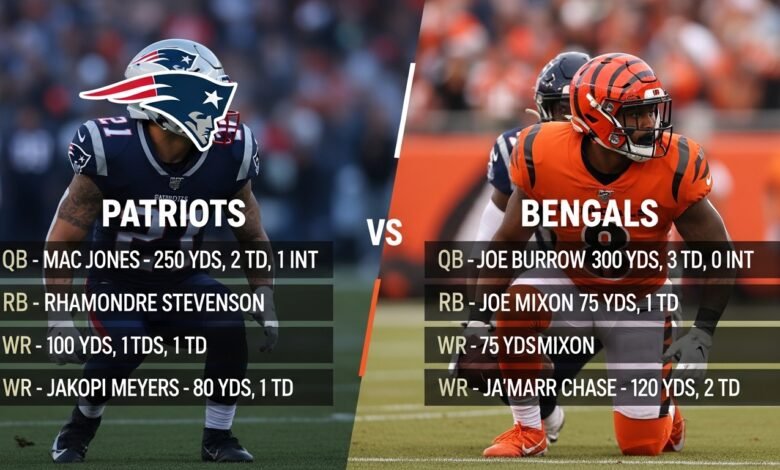
Mac Jones, the Patriots’ quarterback, had a tough outing. He completed 18 of 29 passes for 197 yards, 1 touchdown, and 2 interceptions. His inconsistency and poor decision-making hurt New England’s chances throughout the game.
Jones faced constant pressure from the Bengals’ pass rush and struggled to find rhythm. His two interceptions came at critical moments, killing drives and giving Cincinnati short fields to work with.
When reviewing the New England Patriots vs Bengals match player stats, Jones’s turnovers and lack of efficiency were the biggest factors in the Patriots’ loss.
Joe Burrow’s Precision Passing
Joe Burrow, the Bengals’ star quarterback, had another impressive performance. He completed 26 of 34 passes for 312 yards and 3 touchdowns. His accuracy, poise, and ability to read defenses were on full display.
Burrow’s chemistry with his receivers and quick release kept the Patriots’ defense on their heels. He spread the ball around effectively and made smart decisions under pressure.
Looking at the New England Patriots vs Bengals match player stats, Burrow’s efficient passing attack was the engine that drove Cincinnati’s victory.
Rhamondre Stevenson’s Tough Running
Rhamondre Stevenson, the Patriots’ running back, did his best to keep New England competitive. He rushed for 82 yards on 17 carries and scored a touchdown. His power and determination were evident on every carry.
Stevenson broke tackles, fought for extra yards, and kept the chains moving when the passing game struggled. His touchdown run in the second quarter gave the Patriots hope early on.
The New England Patriots vs Bengals match player stats show that Stevenson was one of the few bright spots for New England’s offense.
Joe Mixon’s Balanced Attack
Joe Mixon, the Bengals’ versatile running back, had a productive day. He rushed for 74 yards on 18 carries and caught 4 passes for 31 yards. His ability to contribute in both the run and pass game kept the Patriots’ defense guessing.
Mixon’s patient running style and ability to find holes kept drives alive. His contributions in the passing game gave Burrow a reliable safety valve.
In the New England Patriots vs Bengals match player stats, Mixon’s all-around game was a key factor in Cincinnati’s offensive balance.
Ja’Marr Chase’s Explosive Plays
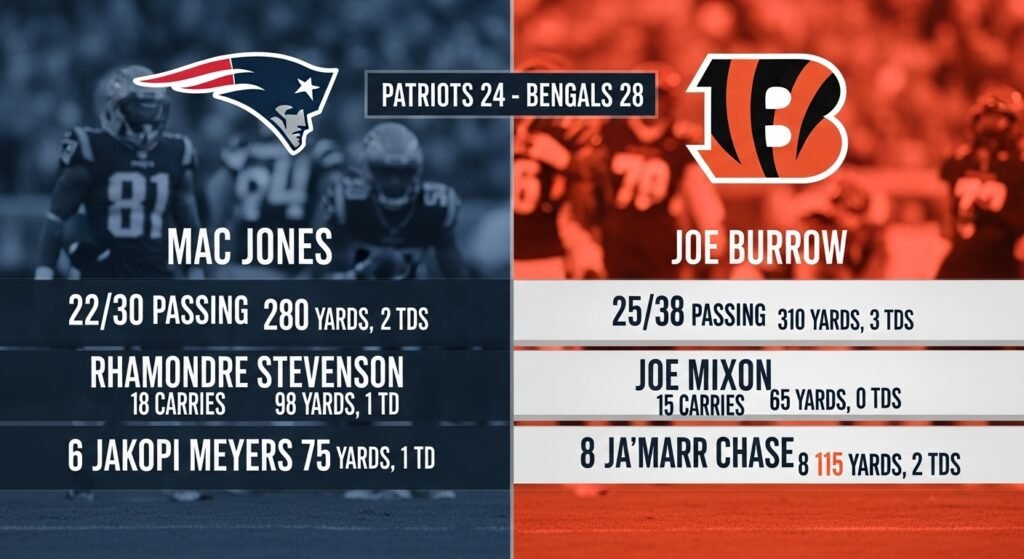
Ja’Marr Chase, the Bengals’ dynamic receiver, torched the Patriots’ secondary. He caught 8 passes for 141 yards and 2 touchdowns, including a 61-yard bomb that broke the game open.
Chase’s speed, route running, and ability to make contested catches make him one of the NFL’s most dangerous weapons. His chemistry with Burrow continues to be a game-changer.
Looking at the New England Patriots vs Bengals match player stats, Chase’s explosive plays were the difference-maker in the passing game.
DeVante Parker’s Limited Impact
DeVante Parker, the Patriots’ veteran receiver, had a quiet game. He caught just 3 passes for 42 yards, struggling to get separation against Cincinnati’s defense.
Parker’s inability to create big plays limited the Patriots’ offensive options. His lack of production put more pressure on the running game and tight ends.
The New England Patriots vs Bengals match player stats reveal that Parker’s quiet performance hurt New England’s ability to move the ball consistently.
Matthew Judon’s Defensive Pressure
Matthew Judon, the Patriots’ All-Pro edge rusher, was a bright spot on defense. He recorded 1.5 sacks, 3 quarterback hits, and constant pressure on Joe Burrow.
Judon’s speed and power forced the Bengals to adjust their protection schemes. His relentless motor kept him in plays and disrupted Cincinnati’s timing.
When analyzing the New England Patriots vs Bengals match player stats, Judon’s defensive dominance was one of the few things keeping the Patriots competitive.
Trey Hendrickson’s Pass Rush
On the Bengals’ side, Trey Hendrickson had a strong showing. He recorded 2 sacks and 4 quarterback hits, applying constant pressure on Mac Jones.
Hendrickson’s speed off the edge and relentless pursuit kept the Patriots’ offensive line on their heels. His disruption in the backfield led to hurried throws and mistakes.
The New England Patriots vs Bengals match player stats highlight Hendrickson’s pass rush as a key factor in Jones’s struggles.
Turnovers: The Game-Changing Stat
Turnovers often decide NFL games, and this one was no exception.
Patriots: 2 interceptions, 1 fumble
Bengals: 0 turnovers
Jones’s two picks and a fumble by the Patriots gave the Bengals extra possessions and short fields. Cincinnati capitalized with touchdowns on two of those turnovers.
Clean football wins games, and the New England Patriots vs Bengals match player stats show how ball security made all the difference.
Third Down Efficiency: Bengals Dominate
Third-down conversions keep drives alive and control the clock. Here’s how both teams performed:
Patriots: 3-of-13 (23%)
Bengals: 8-of-15 (53%)
The Bengals’ ability to convert on third down kept their offense on the field and wore down the Patriots’ defense. New England struggled to sustain drives consistently.
The New England Patriots vs Bengals match player stats reveal that third-down efficiency was a major factor in Cincinnati’s control of the game.
Time of Possession: Bengals Control the Clock
Controlling the clock keeps your defense fresh and limits your opponent’s opportunities. Here’s how both teams did:
Patriots: 24:12
Bengals: 35:48
The Bengals dominated time of possession, keeping the Patriots’ offense off the field and limiting their chances. Long, sustained drives wore down New England’s defense.
The New England Patriots vs Bengals match player stats show that Cincinnati’s ability to control the game’s tempo was a key advantage.
FAQs
1. Who threw for the most passing yards?
Joe Burrow led with 312 passing yards and 3 touchdowns for the Bengals.
2. Which running back had more rushing yards?
Rhamondre Stevenson had 82 rushing yards, while Joe Mixon had 74 yards.
3. Who had the most receiving yards?
Ja’Marr Chase led all receivers with 141 yards and 2 touchdowns.
4. How many sacks did Matthew Judon have?
Matthew Judon recorded 1.5 sacks and 3 quarterback hits.
5. Which team had more turnovers?
The Patriots had 3 turnovers (2 interceptions, 1 fumble), while the Bengals had none.
6. What was the final score?
The Cincinnati Bengals won 31–17, controlling the game from the second quarter onward.
Conclusion
The New England Patriots vs Bengals match player stats paint a clear picture of how Cincinnati earned this win. Joe Burrow’s efficiency, Ja’Marr Chase’s explosiveness, and the Bengals’ ball security were too much for New England to overcome.
The Patriots showed fight, especially from Rhamondre Stevenson and Matthew Judon, but turnovers and poor quarterback play held them back. When you break down the numbers—passing, turnovers, and time of possession—the Bengals simply executed better.
Stats help us see beyond the scoreboard and understand the how and why of every win and loss. Next time these teams meet, keep an eye on these key categories—they’ll tell you who’s really in control.